
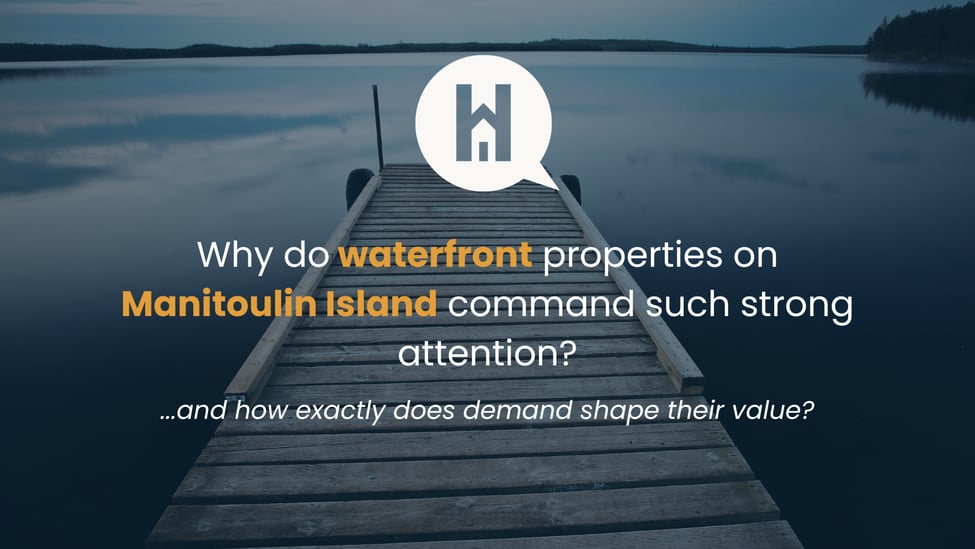
Waterfront demand on Manitoulin Island influences value not just through scarcity, but through lifestyle alignment, long-term ownership patterns, and limited turnover. On the Island, waterfront pricing is shaped as much by stewardship and legacy as it is by market cycles.
Waterfront on Manitoulin Island Is Not a Typical Commodity
In larger urban markets, waterfront property is often treated as a premium feature layered onto an otherwise conventional housing market.
Manitoulin Island operates differently.
Here, waterfront is not simply an upgrade, it is often the reason buyers are here in the first place. Whether it’s Lake Huron, Georgian Bay, inland lakes, or quiet bays and inlets, water access shapes lifestyle decisions in a way that mainland markets rarely replicate.
According to data trends reported by the Canadian Real Estate Association (CREA) and supported by CMHC’s rural housing analysis, smaller lifestyle-driven markets tend to experience longer ownership cycles and less speculative turnover. That pattern is particularly visible on Manitoulin Island, where many waterfront properties are held for decades.
Scarcity here isn’t seasonal, it’s structural.
Why Demand Remains Consistent, Even When Activity Slows
Waterfront demand on Manitoulin Island comes from three overlapping buyer groups:
Retirement and near-retirement buyers seeking long-term lifestyle alignment
Long-term stewards relocating closer to family or simplifying maintenance
Recreational or secondary home buyers building a legacy property
These buyers are typically intentional and values-driven. They are not chasing short-term appreciation; they are pursuing connection to land and water.
Statistics Canada continues to report demographic shifts toward ageing populations in many rural and Northern Ontario regions. As more buyers reach retirement age and seek lower-density, nature-oriented settings, waterfront remains a priority category.
This steady lifestyle-driven demand helps support value stability, even when broader economic cycles fluctuate.
Waterfront Value Is Not Just About the House
One of the most misunderstood aspects of Island waterfront pricing is that value extends beyond square footage.
On Manitoulin Island, waterfront value is shaped by:
Shoreline quality (rocky, sandy, gradual entry, deep water)
Privacy and lot size
Orientation and sun exposure
Four-season access and road maintenance
Septic, well, and infrastructure condition
Two homes of similar size can differ significantly in value based on these elements alone.
This is where mainland comparisons often fail. In urban settings, pricing is often driven by recent comparable sales within tight geographic boundaries. On the Island, shoreline characteristics and long-term usability can influence value more than interior finishes.
The Supply Reality: Why Inventory Stays Limited
Low waterfront inventory is not simply a short-term imbalance between buyers and sellers.
It reflects:
Generational ownership patterns
Emotional attachment to family properties
Limited new shoreline development opportunities
Environmental and zoning protections
CMHC has consistently highlighted that rural and waterfront housing supply is less elastic than urban supply. You cannot quickly “add” new waterfront in response to demand.
This constrained supply helps explain why waterfront pricing on Manitoulin Island tends to show resilience compared to non-waterfront segments.
How High Demand Shapes Pricing Behaviour
High waterfront demand does not necessarily mean dramatic bidding wars. Instead, it tends to shape behaviour in more subtle ways.
Well-positioned waterfront properties often:
Attract serious, qualified buyers quickly
Generate strong early interest when priced appropriately
Hold firm value even if broader activity slows
However, demand does not eliminate the need for thoughtful pricing. Buyers in this market are deliberate. They evaluate shoreline, maintenance history, insurance considerations, and long-term practicality.
Even in strong demand conditions, overpricing can reduce momentum, particularly for properties requiring updates or infrastructure improvements.
Waterfront demand supports value. Strategy protects it.
Lifestyle Premium vs Speculative Premium
In urban centres, waterfront often carries a speculative premium, buyers anticipate short-term appreciation.
On Manitoulin Island, the premium is typically lifestyle-based.
Buyers pay for:
Daily proximity to water
Privacy and quiet
Generational memory-building potential
Long-term emotional return
That distinction matters. Lifestyle premiums tend to be steadier over time because they are not tied purely to investor sentiment.
Waterfront demand shapes value on Manitoulin Island through scarcity, stewardship, and lifestyle alignment, not through rapid turnover or speculative cycles.
If you’re buying, understanding shoreline quality and long-term usability matters more than comparing square footage alone.
If you’re selling, recognizing how your specific waterfront characteristics position your property within limited supply can make a meaningful difference.
On Manitoulin Island, water isn’t just an amenity. It’s the foundation of why many people are here.
If you’re considering buying or selling waterfront property on Manitoulin Island and want to better understand how demand is shaping value in your specific area, a planning conversation can help you explore shoreline factors, pricing positioning, and long-term market dynamics, without pressure. Just reach out!